What are Vector Borne Diseases?
According to the World Health Organisation vector borne diseases are defined “as the diseases which are commonly transmitted through vectors”1. A vector is an organism that does not cause disease itself but which spreads infection by conveying pathogens from one host to another, for example the mosquitoes that carry the malaria parasite or dengue virus, snail hosts of schistosomiasis, or rodent reservoirs of leishmaniasis (a disease spread by a small Sandfly).
What would change their range of transmission?
Key components that determine the occurrence of vector-borne diseases include: (1) the abundance of vectors and intermediate and reservoir hosts; (2) the prevalence of disease-causing pathogens suitably adapted to the vectors and the human or animal host; (3) the local environmental conditions, especially temperature and humidity; and (4) the resilience behaviour and immune status of the human population.
The major concerns with vector borne diseases and climate change in Australia are components of the local environmental conditions and the resilience behaviour and immune status of the human population. With climate change there is the potential for the temperature and humidity conditions suitable for a variety of vector borne diseases, in particularly the mosquito vectors for malaria and dengue, to move into areas that they have not been present in before. This would then expose populations with no experience of these diseases which would make them particularly vulnerable.
Significance of Vector Borne Diseases in Relation to Climate Change
The Fourth IPCC Assessment2 has recognised the contribution of climate change to disease and premature deaths. Emerging evidence shows that climate change has:
- Altered distribution of some infectious disease vectors
- Altered seasonal distribution of some allergenic pollen species
- Increased heat wave related deaths
The change in occurrence and distribution of vector borne diseases is of specific importance to estuaries and coastal waterways, particularly those is northern Australia as many of the vectors could potentially utilise the estuaries in their life cycles.
A report by the Australian Medical Association and the Australian Conservation Foundation3, identified dengue as being more likely to be a significant health risk to Australia than malaria. This was because Dengue is already present in Australia, it is more likely to spread rapidly and the Dengue mosquito (Aedes aegypti) prefer to breed in urban environments and feed on humans3. While the Malaria vectors, some Anopheles mosquitoes, are present in Australia, they rarely carry the pathogen and transmission is very rare. However, climate change could also have an impact on the occurrence of malaria in Australia.
The number of reported cases of dengue varies to year throughout the relevant range of the Aedes aegypti. For example, Figure 1 shows the number of cases of Dengue Fever reported in Singapore from 1993 to 2005.
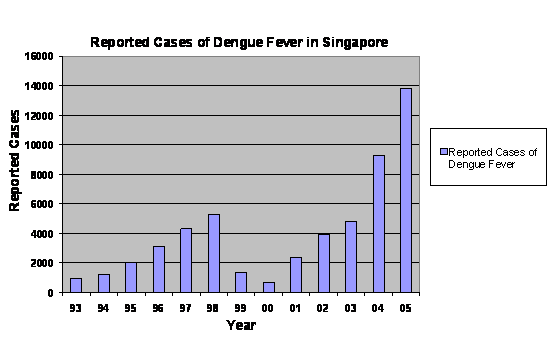
Figure 1. Number of cases of Dengue Fever reported annually in Singapore 1993-2005.
Values from Ministry of Health, Singapore
It is still not clear why the outbreak in 2005 occurred, however, it was not restricted to Singapore. In the same year Indonesia reported more than 80,000 cases with Thailand and Malaysia reporting more than 30 000 cases each. One suggestion has been that Singapore had done such a good job at controlling Aedes aegypti that the level of population immunity had decreased allowing the virus to spread rapidly. This highlights the potential for large outbreaks to occur in Australia, where population immunity would be very low, if suitable climatic conditions present themselves.
Key questions and further research needs
- Will estuary health and management impact the distribution of vector borne disease
- Will the management of vectors influence the health and management of estuaries and coastal wetlands?
Contributors
Geoscience Australia
Griffith University
- “Vector-Borne Diseases.” Encyclopedia of Public Health. Ed. Lester Breslow. Thomson Gale, 2002. eNotes.com. 2006. 21 Jun, 2006 ↩
- Confalonieri, U., B. Menne, R. Akhtar, K.L. Ebi, M. Hauengue, R.S. Kovats, B. Revich and A Woodward (2007). Human Health. Climate Change 2007: Impacts, Adaptation and Vulnerability. Contribution of Working Group II to the Fourth Assessment Report of the Intergovernmental Panel on Climate Change, M.L. Parry, O.F. Canziani, J.P. Palutikof, P.J. van der Linden and C.E. Hanson, Eds., Cambridge University Press, Cambridge UK, 391-431 ↩
- Woodruff, R., Hales, S., Butler, C. and McMicheal A. (2005) Climate Change Health Impacts in Australia: Effects of Dramatic CO2 Emission Reductions. Australian Medical Association and Australian Conservation Foundation, Canberra Australia ↩ ↩