What is the index of habitat variability?
The index of habitat variability is a measure of the distribution and abundance of habitats in Australia’s estuaries and coastal waterways based on the presence and absence of a suite of geomorphic and sedimentary environments. It is based on the generally accepted principle that geomorphic and sedimentary environments provide the substrate for biological habitats in estuaries and coastal waterways1 and that presence and abundance of these environments is directly linked to the relative influence of waves, tides, and river processes (Figure 1)2. The significance of this work is that it directly links the form and function of estuaries to the fate and status of habitats and ecosystems3. Over time, the arrangement and relative abundances of geomorphic and sedimentary environments change in response to natural processes of sediment deposition, transport and erosion in a process called maturity4. Modification by humans can also change the arrangement and abundance of geomorphic and sedimentary environments with implications for the distribution and functioning of habitats.
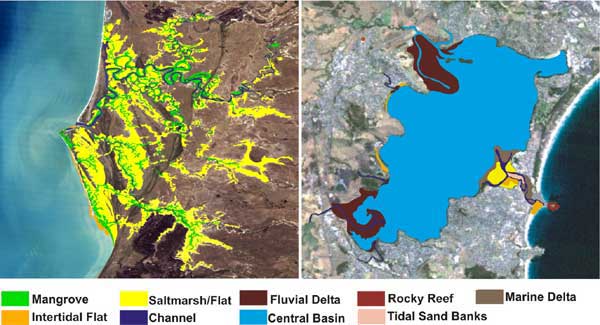
Figure 1. Sedimentary environments in a (a) tide-dominated coastal waterway and (b) a wave-dominated coastal waterway.
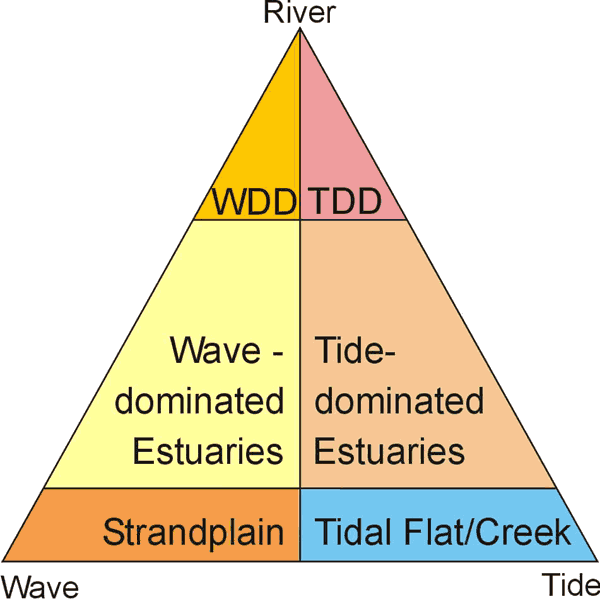
Figure 2. Ternary classification of coastal systems divided into six subclasses (Dalrymple et al., 19922).
How is the index determined?
Distinctive suites of geomorphic and sedimentary environments representing the pristine situation occur in each of the seven major types of coastal waterway in Australia: wave-dominated and tide-dominated deltas, wave-dominated and tide-dominated estuaries, coastal lagoons, embayments, and tidal creeks (Table 1). The suites of environments were determined from a cluster analysis of all sedimentary environments contained in all estuaries and coastal waterways and from the degree of association of individual environments with each type of coastal waterway (as defined by the probability of that environment occurring in each of the seven major types of coastal waterway). The sedimentary environments (sometimes habitats) include barrier and back barrier, central basin, fluvial bayhead delta, flood and ebb tidal deltas; intertidal flats, mangroves/melaleuca, saltmarsh/salt flat and tidal sand banks. Along with diagnostic environments (Diag.), the waterway may contain other environments that are present due to regional factors, such as climate, tidal range, fluvial discharge, and maturity. These environments are termed qualifiers (Qual.) and were defined on the basis of moderate association with each type of coastal waterway. Also, a system may contain environments that are diagnostic of another type of coastal waterway (Non.). A visual inspection of Australia’s coastal waterways indicates that the presence of these environments can represent severe modification to that system by either human or natural processes. The suite of environments are then used as the basis for allocating a score between 0 and 8 for each system, with 0 representing no deviation from the pristine situation and 8 representing maximum deviation. No weighting is applied between diagnostic, qualifier, or non-diagnostic environments. The index for individual estuaries and coastal waterways can thus represent either the absence of environments that should be associated with each type of system and/or the presence of environments that are not generally associated with that type of system.
Wave-dominated Estuary |
Wave-dominated Delta |
Strandplain |
||||||
| Diag. | Qual. | Non. | Diag. | Qual. | Non. | Diag. | Qual. | Non. |
| BBB | FED | TSB | BBB | IF | TSB | BBB | FED | FBD |
| CB | IF | FBD | SM | CB | IF | CB | ||
| FBD | SM | FED | MAN/MEL | SM | TSB | |||
| MAN/MEL | MAN/MEL | |||||||
Tide-dominated Estuary |
Tide-dominated Delta |
Tidal Flat/Creek |
||||||
| Diag. | Qual. | Non. | Diag. | Qual. | Non. | Diag. | Qual. | Non. |
| MAN/MEL | FED | BBB | MAN/MEL | FED | BBB | MAN/MEL | FED | BBB |
| SM | CB | SM | CB | SM | CB | |||
| IF | FBD | IF | FBD | IF | FBD | |||
| TSB | TSB | TSB | ||||||
Table 1. Rules for the calculation of the index of habitat variability
Code to geomorphic and sedimentary environments: BBB = barrier and back barrier; CB = central basin; FBD = fluvial bayhead delta; FED = flood and ebb tidal deltas; IF = intertidal flats; MAN/MEL = mangroves/melaleuca; SM = saltmarsh/salt flat; TSB = tidal sand banks.
Susceptibility of waterways to changes in habitat variability
Recent research investigating the changes to geomorphic and sedimentary environments associated with the evolution of wave and tide-dominated estuaries into wave and tide-dominated deltas; indicates that estuaries are more susceptible to habitat changes associated with increased sedimentation than deltas.This is because over time, with the establishment of a direct and permanent connection between the river and sea in estuaries, sediment delivered to the waterway increasingly bypasses the system and is deposited offshore.It follows that the indices for estuaries, and particularly wave-dominated estuaries, are likely to change faster over time than those associated with wave or tide-dominated deltas which adopt more stable morphologies due to their increased connectivity with the ocean.
Significance of the index of habitat variability
The index of habitat variability that quantifies the presence and/or absence of diagnostic sedimentary environments/habitats can assist resource managers with identifying the following:
- the type of coastal waterway under consideration, which is crucial to the understanding of how the system functions, and is also the basis for comparing systems when allocating resources;
- systems that are significantly perturbed from a pristine state (as defined by conceptual models for Australian systems);
- systems that warrant further investigation because they may be significantly modified or degraded; and
- substrate/habitat distribution and abundances for measures of productivity, biodiversity and habitat condition.
Because the seven major types of coastal waterway in Australia each contain a diagnostic suite of geomorphic and sedimentary environments, the index of habitat variability also allows individual systems to be quantitatively assessed at a national level.
Considerations for interpretation
The greatest habitat integrity is assumed to occur in those systems with the lowest deviations (i.e. those systems that contain geomorphic and sedimentary environments that are close to pristine conditions). The degree to which the facies distribution in an estuary or coastal waterway differs from this idealised distribution is a quantitative measure of its deviation. The index can then be incorporated with other indicators for an overall assessment of the habitat integrity for the purposes of resource management.
Out of 505 coastal waterways studied in Australia, 423 had an index score of between 0 and 2. A visual inspection of these systems indicates that these deviations are mostly due to natural variations based on regional characteristics in the nature of the geomorphic and sedimentary environments, climate, and associated hydrological processes. Systems with a deviation score of 3 or more (n = 82) show deviations due to either natural or anthropogenic activities. For example, the Nerang River (QLD), a wave-dominated delta, has a score of 5. A visual inspection of the geomorphic and sedimentary environments indicates that this system does not contain a barrier, flood/ebb tidal deltas, mangroves, and saltflat/saltmarsh, but does contain tidal sand banks. The absence of environments (and thus habitats) in the Nerang River is due to the intense development of canal estates. This development is likely to have had significant impacts on ecosystem function such as nutrient cycling, species abundance and diversity and physico-chemistry (turbidity and salinity), thus compromising ecosystem integrity. From the visual inspection of systems with high index scores, it is suggested that any system with a score of >3 is flagged for further investigation in the reasons (natural or otherwise) for the high score.
Existing information and data
The Ozcoast and OzEstuaries database contains index values for a total of 505 of Australia’s estuaries and coastal waterways that were mapped as part of the National Land and Water Resources Audit. The geomorphic and sedimentary data were collected by Geoscience Australia and represent the first comprehensive internally consistent nation-wide geoscience inventory for estuaries and coastal waterways ever produced in Australia. Whilst the data only includes total area data and not floristics, the data can form a comprehensive baseline for assessment and preservation of habitats in estuaries and coastal waterways around Australia.
Author
Andrew Heap, Geoscience Australia
- Boyd R., Dalrymple, R.W., and Zaitlin, B.A.1992. Classification of clastic coastal depositional environments. Sedimentary Geology, 80, 139-150. ↩
- Dalrymple, R.W., Zaitlin, B.A., and Boyd, R. 1992. Estuarine facies models: conceptual basis and stratigraphic implications. Journal of Sedimentary Petrology, 62, 1130-1146. ↩ ↩
- Roy, P.S., Williams, R.J., Jones, A.R., Yassini, I., Gibbs, P.J., Coates, B., West, R.J., Scanes, P.R., Hudson, J.P., and Nichol, S., 2002. Structure and function of south-east Australian estuaries. Estuarine, Coastal and Shelf Science, 53, 351-384. ↩
- Heap, A.D., Bryce, S.M., and Ryan, D.A., in review. Quantifying the areas of geomorphic and sedimentary facies in Australian clastic coastal depositional environments: insights into the Holocene evolution of estuaries and deltas. Sedimentary Geology. ↩