What is imposex?
Imposex is the occurrence of induced male sex characteristics superimposed on normal female gastropods, with the development of male sex organs, the penis and/or the vas deferens.
Imposex was first reported in the early 1970s for the common Dogwhelk Nucella lapillus found along the coastline of the United Kingdom1. Nucella lapillus remains the most thoroughly studied species in relation to imposex, although the phenomenon has now been observed and studied in many other species of gastropods worldwide.
What causes imposex?
In a series of studies of the intertidal mud snail Nassarius obsoletus (= Ilyanassa obsoleta), the imposex condition was linked firstly to pollution in marinas, then antifouling bottom paints, and finally the chemical tributyltin (TBT), a major component of the antifouling paints2. This was confirmed by long-term field and laboratory experiments with N. lapillus34, which showed that the bioaccumulation of tin within the female correlated with an increase in the development of imposex. Gastropods bioaccumulate TBT and its endocrine disruptive effects result in elevated testosterone levels giving rise to imposex5.
Some background information
The fouling of the hulls of vessels by marine organisms such as barnacles, mussels and algae, is a historic problem that hinders the operation of vessels in terms of both speed and maneuverability. Water flow over the hull is more turbulent resulting in increased drag through the water with consequent reduced fuel efficiency. Such inefficiencies are obviously extremely costly to the shipping industry if they are not addressed adequately.
Initially, copper was used as the major active ingredient to prevent fouling in the marine environment. To increase effectiveness, particularly to algae, secondary biocides were added such as lead, mercury or arsenic compounds. In the search for more efficient antifoulants, attention turned to tributyltin (TBT) and this was first incorporated in antifouling paints in the early 1960s. As TBT proved to have the stronger biocide properties, it’s use in antifouling agents grew rapidly during the 1970s.
Although antifouling agents are of course highly toxic by design, TBT is probably the most toxic substance that has ever been deliberately introduced to the marine environment and its widespread use has often led to detrimental effects on non-target organisms. It can induce imposex, and cause other adverse biological effects even though it may be present at very low concentrations in the water column.
The scientific literature detailing the adverse impacts of TBT on the aquatic environment is now quite extensive. Apart from imposex, a wide variety of acute and chronic toxic effects on numerous aquatic organisms have been reported. In addition to direct mortality, sublethal effects include growth and behavioural abnormalities, reduced larval growth, reproductive failure, immune system dysfunction, and nervous system disorders. These effects can be observed across a range of water concentrations of TBT, depending on the sensitivity of the species6.
Significance of imposex
Gibbs and Bryan7 described three distinct stages of imposex in Nucella lapillus as early, intermediate and late, with reproductive failure the ultimate outcome. They went on to propose the use of Nucella lapillus as a bioindicator of TBT contamination and developed the relative penis size index (RPSI) as a measure of imposex8.
The significance of imposex is therefore two-fold:
- The adverse biological effects of the superimposed male sex characteristics on females. In some species, the vas deferens interferes with the oviducts leading to infertility and population decline5.
- Measurement of imposex can provide a relatively rapid and inexpensive indication of the status of pollution by TBT in a given ecosystem9.
Waterways most susceptible to imposex
The incidence of imposex is greatest in areas that have a high frequency of boating and shipping activity.
From the late 1980s onwards, legislation restricting the use of TBT as an antifoulant has been introduced throughout different parts of the world. TBT-based antifouling paints have been banned for vessels less than 25 m in length. Large ships (greater than 25m long) are exempt from the ban on the use of TBT. Since then, a number of studies over recent years have now reported on the recovery of populations previously suffering from imposex1011.
However, despite the introduction of regulations limiting its use worldwide, pollution by TBT is still considered a problem in parts of the world subjected to heavy shipping traffic, particularly around ports used by large commercial vessels12. TBT may also be present as a contaminant in the sediments of ports and marinas, a legacy of its widespread pre-ban use. Although TBT is relatively stable in anaerobic sediments, it is expected to decompose in aerobic sediments. Even so, contaminated sediments may be a source of TBT to living marine organisms, whereas once they acted as a sink.
Considerations for measurement and interpretation
Nias et al.13 found imposex in L. vinosa at 14 of the 20 sites sampled, but reported that laboratory experiments showed other factors such as copper and environmental stress may also induce imposex. That imposex in some species may be a less specific indicator of TBT pollution than previously thought has also been noted by Evans et al. 10, who nevertheless concluded that TBT has been the major cause of imposex in N. lapillus, and measuring it is still valuable in monitoring the recovery of populations.
Mensink et al.14 found juvenile Buccinum undatum exposed to TBT soon after hatching developed imposex in a dose dependent manner, whilst adult females exposed to the same conditions showed no signs of imposex. If this applies to other species and imposex is irreversible in individuals as it is for most species15, then frequency measures of imposex may be confounded by the life-time of the species concerned. This may not present a problem for species with shorter life spans, but there may be a considerable lag time for longer-lived species between lower TBT levels in the environment and correspondingly lower observed incidences of imposex.
Existing information and data for Australia
In Australia, studies concerned with TBT contamination have been fairly limited131516. Imposex studies have been carried out on Thais orbita in Port Phillip Bay915, Thais orbita and Morula marginalba from the NSW coast16, and Lepsiella vinosa from southern Australia13. These studies comprised surveys of the frequency and intensity of imposex in the selected species at specific sites of interest.
Foale15 found imposex indices to correlate strongly with distance from marinas, but not with average TBT body burdens. Specimens transplanted to sites where high imposex indices were recorded failed to develop higher levels of imposex than those left at a control site. Foale15 concluded that imposex in T. orbita individuals was irreversible and that the incidences recorded in his study arose from previous TBT contamination that has since been degraded in the environment and eliminated from the organisms’ tissues.
In a follow up study from Port Phillip Bay, Rees et al.9 found imposex to still occur widely in the gastropod Thais orbita (Fig. 1, Fig. 2), with its incidence greatest in areas that had high boating and shipping activities. Figure 3 shows the changes in imposex between 199215 and 19999 as measured by the relative penis size index (RPSI), which is calculated by dividing the mean ratio of penis weight to body weight (without the shell) of the females by the equivalent mean ratio of the males15. Compared to Foale15, both the extent and severity of imposex had reduced as shown by the sharp declines in RPSI. By inference, this means that pollution by TBT in Port Phillip Bay had decreased and that the bans limiting its use to vessels greater than 25 m in length, in place since 1989, had been effective. Nevertheless, TBT pollution was still an issue at Williamstown, where the RPSI recorded a small increase. At locations adjacent to major ports, TBT from large vessels, ship maintenance activities, and release from historically contaminated sediments, continued to pollute habitats.
These findings were consistent with increasing international evidence, and Rees et al.9concluded that the incidence of imposex, and therefore TBT pollution, would continue to decline in Port Phillip Bay as long as the bans remained in place. If the trends observed continue, then it is unlikely, with the notable exception of commercial ports, that TBT will pose a threat to the health of marine habitats in Port Phillip Bay.
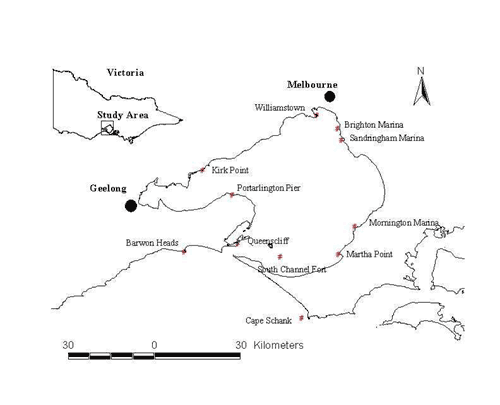
Figure 1. Sampling sites for Thais orbita in and adjacent to Port Phillip Bay, Victoria, Australia.
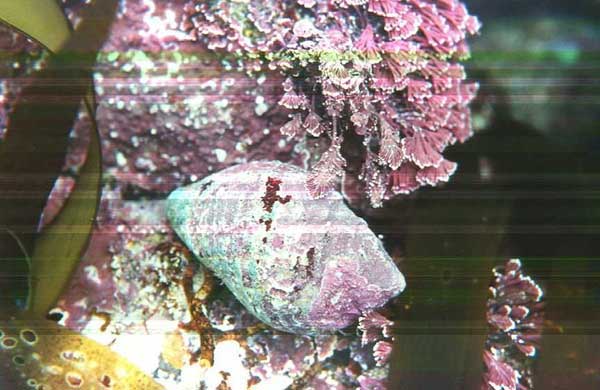
Figure 2. Photograph of Thais orbita. Photo: Guy Werner ©
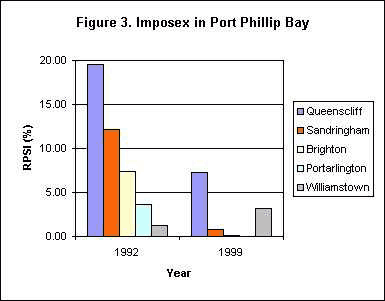
Figure 3. Imposex in Port Phillip Bay.
More information on Toxicants.
Authors
Bruce Brady, Marine and Freshwater Resources Institute (MAFRI), Victoria
C. M. Rees, Marine and Freshwater Resources Institute (MAFRI), Victoria
G. J. Fabris, Marine and Freshwater Resources Institute (MAFRI), Victoria
- Blaber, S. J. M. 1970. The occurrence of a penis-like outgrowth behind the right tentacle in spent females of Nucella lapillus. Proceedings of the Malacological Society of London 39, 231-233. ↩
- Smith, B. S. 1981. Tributyltin compounds induce male characteristics on female mud snails Nassarius obsoletus = Ilyanassa obsoleta. Journal of Applied Toxicology 1, 141-144. ↩
- Gibbs, P. E. and Bryan, G. W. 1986. Reproductive failure in populations of the dog-whelk, Nucella lapillus, caused by imposex induced by tributyltin from antifouling paints. Journal of the Marine Biological Association of the United Kingdom 66, 767-777. ↩
- Bryan, G. W., Gibbs, P. E., Burt, G. R. and Hummerstone, L. G. 1987. The effects of tributyltin (TBT) accumulation on adult dog-whelks, Nucella lapillus: long-term field and laboratory experiments. Journal of the Marine Biological Association of the United Kingdom 67, 525-544. ↩
- Matthiessen P. and Gibbs P.E. 1998. Critical appraisal of the evidence for tributyltin-mediated endocrine disruption in mollusks. Environ. Toxicol. Chem. 17, 37-43. ↩ ↩
- Fent K. 1996. Ecotoxicology of organotin compounds. CRC Crit. Rev. Toxicol. 26, 1-117 ↩
- Gibbs, P. E. and Bryan, G. W. 1986. Reproductive failure in populations of the dog-whelk, Nucella lapillus, caused by imposex induced by tributyltin from antifouling paints. Journal of the Marine Biological Association of the United Kingdom 66, 767-777. ↩
- Gibbs, P. E., Bryan, G. W., Pascoe, P. L. and Burt, G. R. 1987. The use of the dog-whelk, Nucella lapillus, as an indicator of tributyltin (TBT) contamination. Journal of the Marine Biological Association of the United Kingdom 67, 507-523. ↩
- Rees, C. M., Brady, B. A. and Fabris, G. J. 2001. Incidence of imposex in Thais orbita from Port Phillip Bay (Victoria, Australia), following 10 years of regulation on use of TBT. Marine Pollution Bulletin 42, 873-878. ↩ ↩ ↩ ↩ ↩
- Evans, S. M., Leksono, T. and McKinnell, P. D. 1995. Tributyltin pollution: a diminishing problem following legislation limiting the use of TBT-based anti-fouling paints. Marine Pollution Bulletin 30, 14-21. ↩ ↩
- Smith, P. J. 1996. Selective decline in imposex levels in the Dogwhelk Lepsiella scobina following a ban on the use of TBT antifoulants in New Zealand. Marine Pollution Bulletin 32, 362-365. ↩
- Morgan, E., Murphy, J. and Lyons, R. 1998. Imposex in Nucella lapillus from TBT contamination in south and south-west Wales: a continuing problem around ports. Marine Pollution Bulletin 36, 840-843. ↩
- Nias, D. J., McKillup, S. C. and Edyvane, K. S. 1993. Imposex in Lepsiella vinosa from southern Australia. Marine Pollution Bulletin 26, 380-384. ↩ ↩ ↩
- Mensink, B. P., Everaarts, J. M., Kralt, H., Ten Hallers-Tjabbes, C. C. and Boon, J. P. 1996. Tributyltin exposure in early life stages induces the development of male sexual characteristics in the common whelk, Buccinum undatum. Pollution Responses in Marine Organisms 8th International Symposium (PRIMO 8) (Hinton D. E. ed.) 42, 151-154. ↩
- Foale, S. 1993. An evaluation of the potential of gastropod imposex as a bioindicator of tributyltin pollution in Port Phillip Bay, Victoria. Marine Pollution Bulletin 26, 546-552. ↩ ↩ ↩ ↩ ↩ ↩ ↩ ↩
- Wilson, S. P., Ahsanullah, M. and Thompson, G. B. 1993. Imposex in neogastropods: an indicator of tributyltin contamination in eastern Australia. Marine Pollution Bulletin 26, 44-48. ↩ ↩