What is the greenhouse effect?
The greenhouse effect is an important part of the Earth’s climate without which the planet would be a far colder place. The effect is natural and not new. When sunlight hits the surface of the earth it is absorbed and the visible light (short wave radiation) is converted to heat (infrared or long wave radiation) (Fig. 1) which is radiated back into the atmosphere towards space.
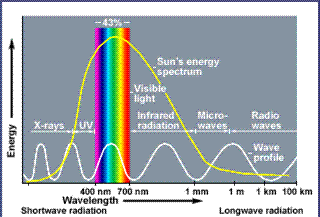
Figure 1. A schematic of the electromagnetic spectrum, showing the Sun’s energy output in relation to wavelength.
Some gases in the atmosphere (the so called greenhouse gases: such as carbon dioxide, water vapour, methane, etc.) absorb the infra red radiation (heat) which is converted into kinetic and potential energy. Eventually these molecules then emit heat back into the atmosphere as infrared radiation. Some of this infrared radiation is absorbed by other greenhouse gases and some is absorbed at the earth’s surface and the cycles of absorption, conversion and emission are repeated (Fig. 2). Essentially this process slows the loss of heat to space, keeping the earth’s surface warmer than it would be without the greenhouse gases. Without this “greenhouse” the Earth’s atmosphere would be an average of about 30-35 oC cooler and life as we know it would not exist.
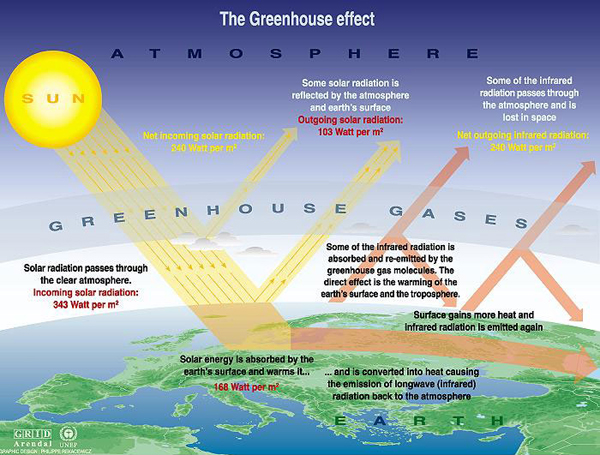
Figure 2. An overview of the Greenhouse Effect. From IPPC Working Group 1 contribution, Science of Climate Change, Second Assessment Report 19961.
The enhanced greenhouse effect, sometimes referred to as climate change or global warming, is the impact on the climate from the additional heat retained due to the increased amounts of carbon dioxide and other greenhouse gases that humans have released into the earths atmosphere since the industrial revolution.
What is causing the enhanced greenhouse effect?
Since the mid 1800’s the average concentration of CO2 in the earth’s atmosphere has risen from about 280 parts per million (ppm) to just over 383 ppm in 2007, and methane from about 800 part per billion (ppb) to around 1790 ppb in 2008 (Fig. 3).
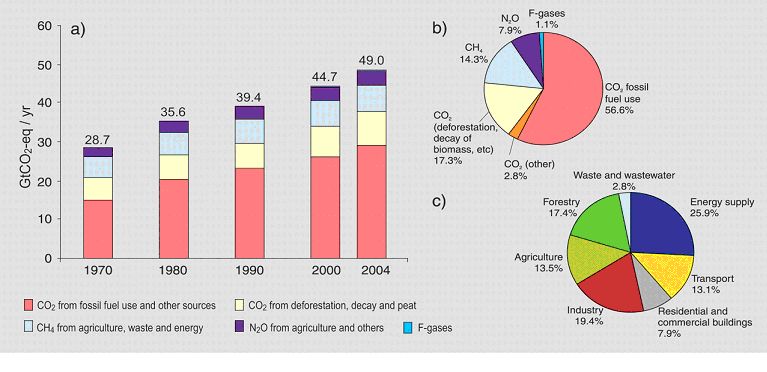
Figure 3. Global atmospheric concentrations of four greenhouse gases. From the IPCC 2007 4th Assessment Report2.
While these changes represent only a very small change to the overall composition of the earth’s atmosphere, it is a significant change to its capacity to absorb and emit heat. The main contributors are changes to the carbon cycle that have led to increased levels of carbon dioxide in the earth’s atmosphere in the last 200 years. These include reduced CO2 removal and storage through deforestation; direct CO2 production from the burning of fossil fuels and CO2 released from cement production.
The increased release of nitrogen oxides (NOx) from burning fossil fuels and soil denitrification (particularly with the introduction of high nitrogen fertilizers) and intensive production of livestock such as cows and pigs which produce methane have also contributed to the enhanced greenhouse effect.
The differing chemical structures of these gases produce a different absorption spectra or wavelengths of radiation which they will absorb or let through. An important aspect of this is that even if the atmosphere is saturated with water vapour there are wavelengths of infrared radiation that it will not be absorbed. However, CO2 and other greenhouse gases can absorb the infrared radiation at the wavelengths missed by water vapour.
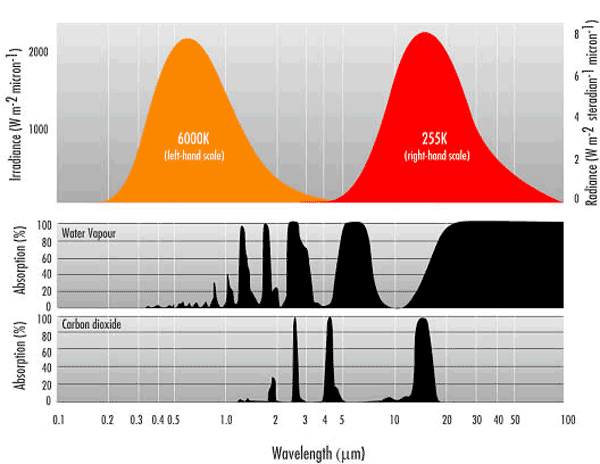
Figure 4. The radiation Absorption characteristics of Water Vapour and Carbon Dioxide. From the Bureau of Meteorology (BOM)3.
The capacity for a gas to absorb long wavelength (Infrared) radiation and the length of time it spends in the atmosphere both impact on its potential to act as a greenhouse gas. This potential is often expressed as its CO2 equivalent, or the number of equivalent molecules of CO2 it would take to absorb as much heat as one molecule of the gas in question over a given time period (usually 100 years). The CO2 equivalents of some greenhouse gases are shown in table 1 below.
| CO2 | 1 |
| CH4 | 21 |
| N20 | 310 |
| HFC’s | 140 ~ 11,700 |
| PFC’s | 6,500 ~ 9,200 |
| SF6 | 23,900 |
Table 1. CO2 equivalents of some greenhouse gases. From the US Environmental Protection Agency4.
Note that while methane (CH4) and N2O both absorb more heat per molecule than CO2, CO2 concentrations are much higher (100 -100 times higher respectively) and therefore have more overall affect on the enhanced greenhouse affect. Residence time plays an important role as well as concentration. While water vapour is by far the greatest contributor to the natural greenhouse effect, it spends so little time in the atmosphere (days rather than centuries) that it is not well mixed and thus its affects on temperature are short lived and very localised.
Considerations for measurement and interpretation
While we can directly measure the levels of CO2 and other greenhouse gases in the atmosphere and we know how they have changed in the past, the extent to which their concentrations will change in the future is uncertain (Fig. 5). How much greenhouse gas will be emitted in the future is dependent on a number of complex factors, such population change, economic development, changes to technology along with social and political ideology. Projections of future emissions of greenhouse gases are made based on scenarios, or plausible descriptions of the future. A scenario provides a set of assumptions that describe what might happen in the future [4]. As the interactions between each of the factors within a scenario and how each of the factors will affect greenhouse emission are not completely understood, uncertainty is introduced at every step of the projection process. The possible error in projected emissions is carried into the projected levels of greenhouse gases and further compounded when a projection of temperature change is made from the greenhouse gas concentrations.
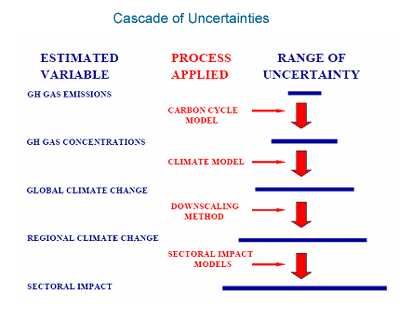
Figure 5. Flow chart illustrating that uncertainty is introduced into predictions of impacts at every step, and these uncertainties accumulate. From Pittock 20055.
The uncertainty of the temperature projections are further increased due to our limited understanding of the exact sensitivity of climate to various concentrations of greenhouse gases, i.e. how much will temperature rise from a given increase in CO2 levels (Fig. 6). This is even further complicated by the issue of feedbacks in which higher temperatures will lead to increased release of greenhouse gases leading to even higher temperatures and thus releasing more greenhouse gas and so on. An example would be the release of methane from permafrost (ground currently frozen all year round) as it thaws in the Northern Hemisphere.
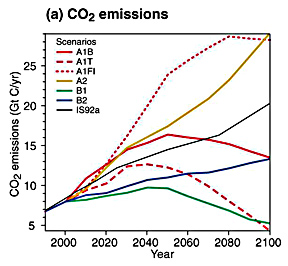
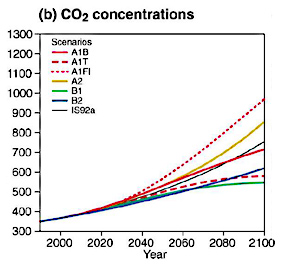
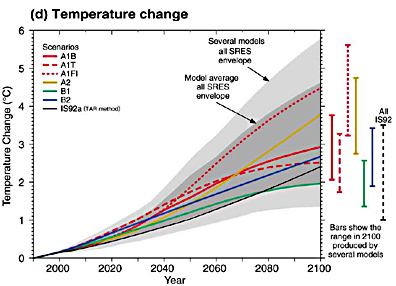
Figure 6. Projections of a) CO2 emissions, b) atmospheric CO2 concentrations, and d) temperature change, associated with the IPCC emission scenarios. Note the levels of uncertainty associated with the projections of temperature change. From the IPCC special report on emission scenarios 20006).
There are various flow on effects of global temperature increase due climate change. These include changes to rainfall conditions, storm intensity or frequency and sea level rise. Recent work has begun understanding the impact climate change has on these environmental parameters. For example Timbal et al7 has attributed the drying trend in south-west Australia using natural and human induced forcing factors. This studied recognised the anthropogenic contribution to the drying trend. The South Eastern Australian Climate Initiative have likewise studied climate drivers and future projections for the Murray Darling Basin. The impact of clouds and aerosols on climate trends is also important for future climate predictions and the CSIRO have recently completed work studying the influence of aerosols on rainfall patterns.
Observed Changes in Australia
Air Temperature
Air temperature is regularly measured across Australia. The map in figure 7 shows the average trend in annual mean temperature for areas in Australia for the period 1950-2008 as degrees Celsius per decade, eg. 0.2 oC/10yrs for 50 years equals a 1 oC increase in mean annual temperature since 1950.
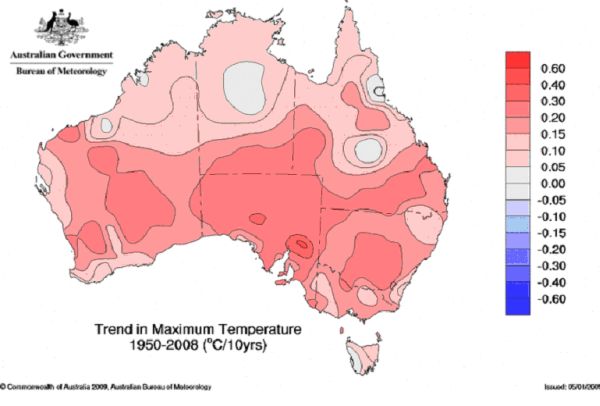
Figure 7. Average trend in annual mean temperature in Australia (ºc/10yrs – 1950-2001) From The Bureau of Meteorology8.
Rainfall
Rainfall is regularly measured across Australia. The map in figure 8 shows the average trend in total rainfall for Australia for the period 1950-2008 as millimetres per decade, eg. +20mm/10yrs for 50 years equals a 100 millimetre increase in average rainfall since 1950.
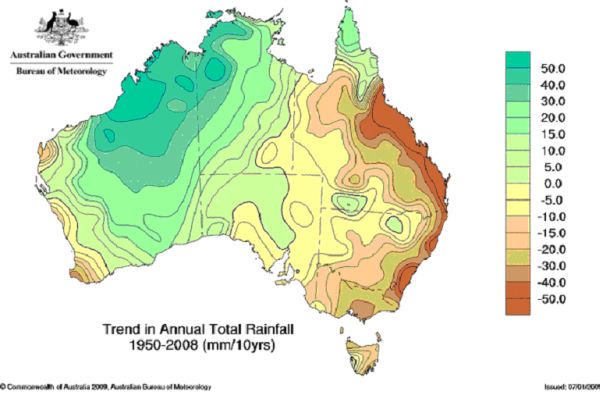
Figure 8. Average trend in total rainfall in Australia (mm/10yrs) 1950-2008. From The Bureau of Meteorology 9.
Southwest Western Australia Rainfall and Runoff
A major factor governing the form and function of coastal waterways is the availability of water. Rainfall is predicted to decrease for most of the populated areas of Australia and this will impact how much water can be collected and environmental flows. As discussed above the relationship between rainfall and runoff is not linear. Measurements taken for the reservoirs that supply Perth (Fig. 9) show that for the period between 1974 and 1996 the average rainfall decreased by 14% but the inflow to the reservoirs for the same period decreased by 48%. In the past ten years (1996-2006) the rainfall has decreased by another 7% and the inflow by another 16%. Factors such as increased evaporation and decreased soil moisture are combining with the decreased rainfall to produce a much greater decrease in inflow.
![Total annual inflow of water (GL) received into dams near Perth, Western Australia from 1911 to 2007. From Water Corporation [10].](/wp-content/uploads/2016/09/oze_fs_009_09.gif "Total annual inflow of water (GL) received into dams near Perth, Western Australia from 1911 to 2007. From Water Corporation [10].")
Figure 9. Total annual inflow of water (GL) received into dams near Perth, Western Australia from 1911 to 2007. Courtesy of the Water Corporation of Western Australia10.
The other interesting point about this example is the apparent stepwise nature of the changes. These changes are not slow gradual variations that can be monitored and accounted for through planning or evolution. These are sudden rapid transformations in conditions that could devastate an ecosystem dependant on the inflow.
Sea level Rise
Sea level changes in response to fluctuations in ocean mass and the expansion or contraction of water as it cools or warms11. Under increased global temperatures seawater expands as it warms and increases in mass due to the melting of glaciers, ice caps and ice sheets. Figure 10 shows the IPCC 2001 projected sea level compared to those observed by tide gauges and satellite altimeters for the period 1990 to 2006. The figure shows sea level rising at a rate that exceeds these initial projections. It is important to note that sea level rises at both temporal and spatial scales and thus the rise is not experienced uniformly across the globe. Sea level rise leads to a variety of problems including inundation of coastal ecosystems and infrastructure and saline intrusion into freshwater aquifers.
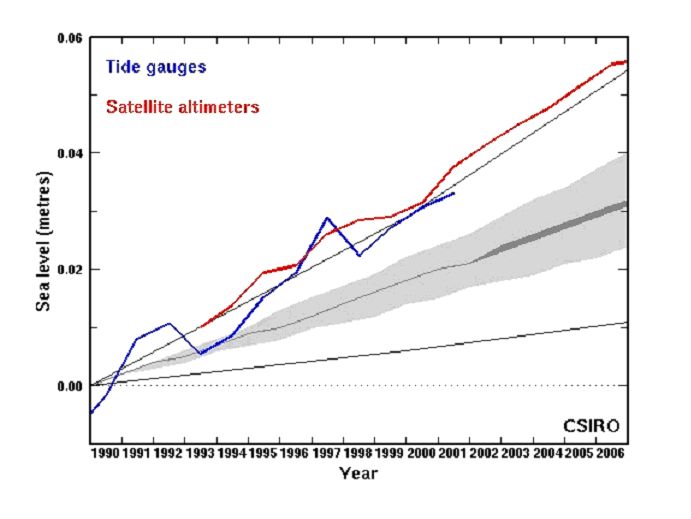
Figure 10. Global mean sea level from 1990 to 2006 and those projected by the IPCC 2001. Observed sea level from tide gauges (blue) and satellites (red) have tracked near the upper bound (black line) of the projections. From the CSIRO11.
Ecosystems
In Australia there have been many trends observed in a variety of ecosystems that could be the result of changes to climate. Hughes12 provides a review of these changes that include:
- Changes to woodland distribution and biomass probably due to changes in rainfall and CO2 levels eg. Expansion of rainforest in Queensland and expansion of eucalyptus into subalpine grassland.
- Changes to migration and distribution patterns of birds and other animals eg. the southward contraction of range of the grey headed flying fox and the southward extension of the distribution of the black flying fox,
- The southward extension of the distribution of marine species such as the sea urchins and the introduced European shore crab
Ocean Acidification
CO2 absorption by oceans has led to a decrease in the pH of about 0.1 units from pre industrial levels. This change represents about a 30% increase in the concentration of H+ in seawater.
Storm Frequency
Studies have correlated the frequency of intense cyclones (category 4 or 5 on the Saffir-Simpson scale) with increased water temperature13.
The Climate Projections for Australia
The CSIRO14 has produced a series of projections for climate change in Australia using the IPCC Special Report on Emissions Scenarios15. Annual and seasonal projections have been prepared for the IPCC scenarios that each describe a viable future world emission scenario. For further information on these projections see the Climate Change in Australia technical report 2007. The projected changes in temperature and rainfall for Australia for the year 2030 are shown in figures 11 and 12 below.
Temperature
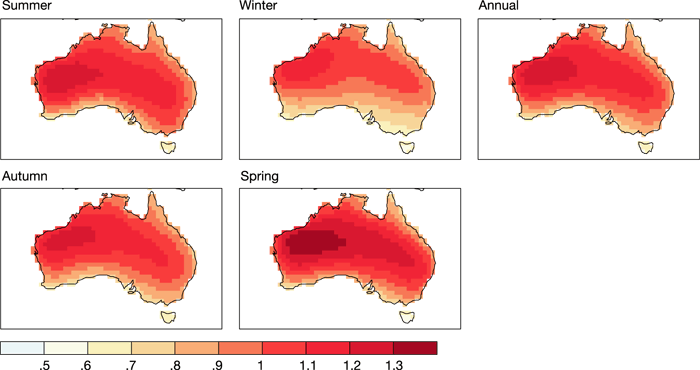
Figure 11. Best estimate (50th percentile) of the changes in average temperature (°C) over Australia for 2030 using the A1B emission scenario for summer, autumn, winter, spring and annual. Reproduced with permission from CSIRO14 1.
Rainfall
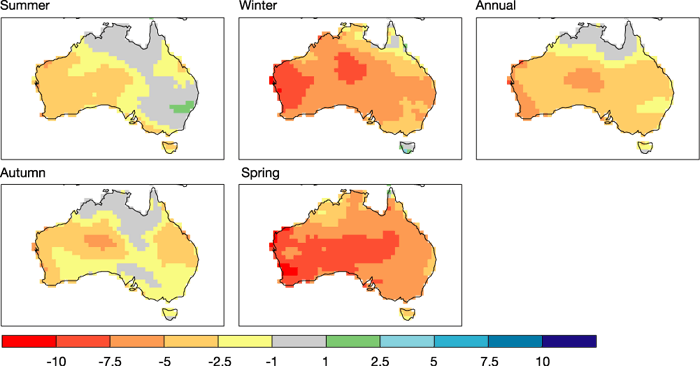
Figure 12. Best estimate (50th percentile) of predicted precipitation change for 2030 in Australia using the A1B emission scenario as a percentage of 1961 – 1990 values for summer, autumn, winter, spring and annual. Reproduced with permission from CSIRO14 1.
Potential Impacts of Climate Change in Australia
Pittock16 has produced a thorough compilation of the effects of climate change in Australia and the likely impacts of those effects. Below is a table showing projected impacts from changes to average temperature or rainfall. While some of the changes projected appear to be small, these are changes to averages which means the ranges of conditions that go into producing them will much larger. Note the severity of the consequences from seemingly small changes (1 or 2 degrees Celsius).
Impacts on Estuaries from Global Warming Projected for Australia
Listed below are some examples of the potential impacts of climate change could have on estuaries. All of these changes have the potential to alter the distribution of species.
Higher Air Temperatures
- Increased evaporation and lower soil moisture affecting runoff to estuaries
- Increased fire risk for surrounding vegetation
- Increased stratification of coastal lakes (with potential anoxic & hypoxic events)
Decreased Rainfall or Changes to Rainfall Patterns
- Decreased runoff and its impact on environmental flows
- Average rainfall might stay the same but how and when it falls could change (Rain falling in very large storms less often)
- Increased Fire risk for surrounding vegetation
Sea Level Rise
- Saline Intrusion with die-back of fresh water wetlands
- Larger or more frequent storm surges impact barrier ridges and or salinity of estuaries (wave dominated estuaries)
Higher Sea Surface Temperatures
- Changes to nutrient cycling
- Changes to primary productivity
- Changes to water temperature of coastal waters
Ocean Acidification
Ocean Circulation Wave Patterns
- Changes to nutrient cycling
- Changes to sediment dynamics and form of estuaries
Vector-borne diseases
- Change in the occurrence and distribution of vectors which utilise coastal waterways in their life cycles.
Key questions and further research needs
- The identification of the aspects of estuaries and coastal systems most sensitive to climate change.
- The interaction between increased CO2 and other factors such as air and , changed runoff quantities and patterns and carbon and nutrient cycles, speciation of trace metals and particle flocculation and their impact of overall estuarine health
- Possible threshold limits, or tipping points, where estuaries ecosystems will no longer be able to function in their current state.
Authors
Geoscience Australia
Department of Climate Change
1Disclaimer – CSIRO does not guarantee that the material or information it has provided is complete or accurate or without flaw of any kind, or is wholly appropriate for your particular purposes and therefore disclaims all liability for any error, loss or other consequence which may arise directly or indirectly from you relying on any information or material it has provided (in part or in whole). Any reliance on the information or material CSIRO has provided is made at the reader’s own risk.
- IPCC (1996) Working Group 1 contribution, Science of Climate Change, Second Assessment Report. ↩
- IPCC (2007). The Fourth assessment report of the Intergovernmental Panel on Climate Change (IPCC). Climate Change 2007: The Physical Science Basis. (Solomon, S., D. Qin, M. Manning, Z. Chen, M. Marquis, K.B. Averyt, M. Tignor and H.L. Miller, Editors). Contribution of the Working Group I to the Fourth Assessment Report of the Intergovernmental Panel on Climate Change. Cambridge University Press, 944pp ↩
- Bureau of Meteorology (Australia) The Greenhouse Effect and Climate Change. ↩
- U.S. Environmental Protection Agency, Office of Atmospheric Programs (2002) Greenhouse gases and global warming potential values: Excerpt from the inventory of U.S. greenhouse emissions and sinks: 1990-2000 ↩
- Pittock, B. 2005 Global Perspective on Climate Change. Presentation to the Climate Change Impacts and Adaptation in Gippsland stakeholder workshop, September 2005. ↩
- IPCC (2000) Special Report on Emission Scenarios (SRES ↩
- Timbal, B., Arblaster, J.M., and Power, S., 2005. Attribution of the Late-Twentieth-Century Rainfall Decline in Southwest Australia. Journal of Climate, 19:10, 2046-2062. ↩
- Bureau of Meteorology (Australia) The Greenhouse Effect and Climate Change. Average trend in annual mean temperature in Australia . ↩
- Bureau of Meteorology (Australia) The Greenhouse Effect and Climate Change. Average trend in total rainfall in Australia (mm/10yrs) 1950-2008. ↩
- Water Corporation, Western Australia . Rainfall and Stream flow data. ↩
- CSIRO Marine and Atmospheric Research. ↩ ↩
- Hughes, L. (2003) Climate change and Australia: Trends, projections and impacts. Austral Ecology 28 , 423-443. ↩
- Webster, P. J., G. J. Holland, J. A. Curry and H.-R. Chang (2005): Changes in tropical cyclone number, duration and intensity in a warming environment. Science 309, 1844-1846. ↩
- CSIRO (2007) Climate Change in Australia technical report 2007. ↩ ↩ ↩
- IPCC (2000) Special Report on Emission Scenarios (SRES) ↩
- Pittock, B. (ed) (2003) Climate Change: An Australian Guide to the Science and Potential Impacts. Commonwealth of Australia, Australian Greenhouse Office Canberra Australia. 239 pages. ↩