Eutrophication is “an increase in the rate of supply of organic matter to an ecosystem”1. It is a process, not a trophic state.
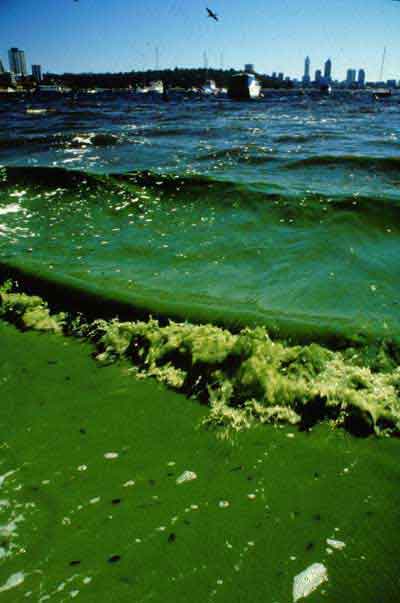
Photo 1. Microcystis bloom in Matilda Bay, Swan-Canning Estuary during February 2000. Photo by Dennis Sarson (University of Western Australia). Used with permission of the Waters and Rivers Commission of Western Australia.
Causes of eutrophication
The main cause of eutrophication in coastal waterways is nutrient overenrichment (nitrogen, phosphorus and silica). Other factors influence plant growth and the build-up of nutrient concentrations, and hence modify (or buffer) the response of a system to increased nutrient loads. These factors include hydrologic residence times, mixing characteristics, water temperature, light climate and grazing pressure.
Nutrients are derived from point sources and nonpoint (or diffuse) sources.
Point-sources of nutrients are more important in areas with large population densities or with significant coastal tourism, and may include:
- industrial outfalls (including those from sewage treatment works);
- wastes from aquaculture production; and
- effluents from ships, yachts & boats.
Nonpoint sources of nutrients are usually of greater concern than point sources because they tend to be larger and more difficult to control. Important nonpoint sources of nutrients include:
- runoff from agricultural areas; and
- urban stormwater.
The Catchment Condition Index and Extent of Native Vegetation give a general indication of the overall catchment condition, and may also be useful for identifying coastal waterways that are at risk of eutrophication.
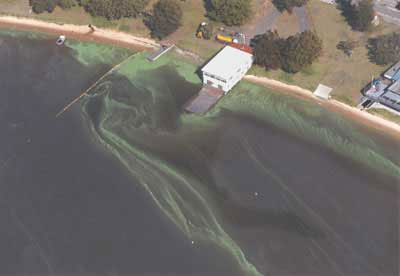
Photo 2. Microcystis aeruginosa bloom in Crawley Bay, Swan-Canning Estuary, WA. Photo courtesy of West Australian Newspapers and used with permission of the Waters and Rivers Commission of Western Australia.
Impacts of eutrophication
Eutrophication is a major national2 and international problem3 because it can lead to:
- an increase in the frequency of: harmful algal blooms (Photo 1), shellfish contamination, anoxic and hypoxic events and fish kills;
- a loss of ecosystem integrity, aquaculture production, fish stocks and amenity value; and
- changes in biodiversity.
Relevant biophysical indicators
An increase in macroalgae or phytoplankton is usually the first ‘visible’ sign that a system is becoming eutrophied. Key indicators of increasing trophic status in the ANZECC/ARMCANZ Australian and New Zealand Guidelines for Fresh and Marine Water Quality [10] include:
- chlorophyll-a concentrations in excess of ANZECC/ARMCANZ guidelines [10]; and
- water column TN and TP concentrations in excess of ANZECC/ARMCANZ guidelines [10].
However, sediments (and benthic communities) are probably the most sensitive part of coastal ecosystems to nutrient enrichment4. Therefore, some scientists feel that management criteria for defining sustainable carbon loading rates are best based on indicators found in sediment4. Some sediment indicators of eutrophied conditions include:
- benthic carbon dioxide fluxes >~100 mmol m-2 d-1 (in wave-dominated estuaries)4;
- denitrification efficiencies < ~40% (in wave-dominated estuaries)4 5 6; and
- benthic production:respiration ratios < 0.34 (in wave-dominated estuaries)4.
TOC:TS ratios of < ~5 7 and Degree of Pyritisation values in the range from 0.55 – 0.93 8 also indicate the predominance of organic matter decomposition by sulfate reduction in sediment – a condition which is often also associated with elevated water column productivity. Increased sedimentation rates are also sometimes associated with eutrophication.
Other potential indicators of changing trophic status include:
- changes in the concentrations of citrulline, pigments and tissue nitrogen (N) in macroalgae – these indicators integrate water column changes over long time frames;
- changes in the diurnal ranges of pH and dissolved oxygen concentrations – large diurnal ranges can indicate higher productivity; and
- shifts in diatom species composition.
More information on nutrients (changed from natural).
- Nixon, S.W. 1995. Coastal marine eutrophication: A definition, social causes, and future concerns. Ophelia 41, 199-219. ↩
- Zann, L.P. 1995. Our sea, our future. Major findings of the State of the Marine Environment Report for Australia, Department of the Environment, Sport and Territories, Canberra. ↩
- National Research Council 2000. Clean Coastal Waters: Understanding and reducing the effects of nutrient pollution. National Academy Press, Washington, DC, USA: 405 pp. ↩
- Eyre, B. and A.J.P. Ferguson 2002. Sediment biogeochemical indicators for defining sustainable nutrient loads to coastal ecosystems, Proceedings of Coast to Coast 2002 – “Source to Sea”, Tweed Heads, pp. 101-104. ↩ ↩ ↩ ↩ ↩
- Berelson, W.M., Heggie, D., Longmore, A., Kilgore, T., Nickolson, G., Skyring, G. 1998. Benthic nutrient recycling in Port Phillip Bay, Australia. Estuarine and Coastal Shelf Science 56, 917-934. ↩
- Heggie, D. T., Skyring, G. W., Orchardo, J., Longmore, A. R., Nicholson, G. J., and Berelson, W M. (1999). Denitrification and denitrifying efficiencies in sediments of Port Phillip Bay: direct determinations of biogenic N2 and N-metabolite fluxes with implications for water quality. Marine Freshwater Research 50, 589-596. ↩
- Berner, R.A. 1983. Sedimentary pyrite formation: An update Geochemica et Cosmochimica Acta 48, 605-615 ↩
- Raiswell, R., Buckley, F., Berner, R.A., and Anderson, T.F. 1987. Degree of pyritization of iron as a palaeoenvironmental indicator of bottom-water oxygenation. Journal of Sedimentary Petrology 58(5) 812-819. ↩